
1 min read
27+ Best Appointment Reminder Email Template Examples & Strategies
💡 An appointment reminder email is a short, pre-written message a practice sends before a scheduled visit, confirming the date, time, provider,...
8 min read

Every clinic knows the sting of an empty chair in a full waiting room. The schedule looks packed on paper, yet the patient never walks in. These missed visits, better known as no-shows, are far more than a small annoyance. They quietly cost practices thousands of dollars each year.
No-shows also stretch your staff thin and push care further out of reach for people who need it. When one in four patients skips a scheduled visit, the math gets ugly fast. A clinic with 20 appointments a day loses roughly 4 to 6 slots daily. Spread that over a few months, and the hit to both revenue and patient health becomes hard to ignore.
The frustrating part is that most of these gaps are preventable. Patients rarely skip out of carelessness or a lack of interest in their own health. More often, something simple gets in the way, like a forgotten date, a ride that fell through, or a bill they were afraid to face. Once you understand the real reasons behind no-shows, you can start closing those gaps one by one.
In this guide, we will walk through the top five reasons patients miss medical appointments. Along the way, you will learn how much these gaps really cost, both in dollars and in health outcomes. You will also see practical strategies that clinics use to bring patients back to the schedule.
We will pay special attention to how eCW users can put their scheduling data to work with the right tools. When appointments are missed, the fallout reaches far beyond a single open slot. Let us start by looking at just how big this problem has really become.
Before you can fix no-shows, it helps to see the full scale of them. The numbers are steeper than most practices expect, and they touch both the balance sheet and patient health.
Across the United States, outpatient clinics face an average no-show rate of 20% to 30%. That means for every ten patients booked, two or three never arrive. Each of those gaps often represents $150 to $300 in lost revenue. For a small practice with 20 daily appointments, a 25% no-show rate can drain up to $30,000 a month.
Stretch that monthly loss across a full year, and it can top $300,000. Money on that scale is not just a line item. It is the budget a clinic would otherwise spend on staff, equipment, and better patient services. On top of that, teams rack up overtime as they scramble to reschedule and catch up.
No-shows not only bruise the clinic. They hurt patients, too. When someone skips a visit, chronic conditions can go unchecked, and preventive care slips. A missed follow-up after surgery, for example, can spiral into complications and a costly readmission.
The damage spreads beyond one person. Empty slots that were never canceled still block the calendar, so other patients wait longer for care. As waitlists grow, access shrinks for the whole community. In short, missed visits are one of the most stubborn healthcare appointment barriers we face, and solving them starts with the root causes.
Most no-shows trace back to a handful of very human problems. Understanding each one makes it far easier to design a fix that actually sticks.
The most common cause of no-shows is simple: people forget. Between work, school, and childcare, a health visit can slide down the list. Appointments booked weeks ahead are especially easy to lose track of. Without a reliable nudge, patients cancel late or miss the slot entirely.
For many patients, especially in rural or underserved areas, getting there is the hard part. Long drives, spotty public transit, or no car at all can make a visit feel out of reach. Even in cities, heavy traffic and scarce parking add friction that tips some patients toward skipping.
Fear is an easy driver to overlook. Some patients dread a procedure, a test result, or the chance of bad news. Others carry a rough past experience with a provider. That quiet anxiety pushes visits off the calendar, especially in mental health and specialty care.
Out-of-pocket cost is a fast-growing reason patients stay home. Even people with insurance can face steep co-pays, deductibles, or an old balance. When a visit feels too expensive today, some choose their wallet over their long-term health. That trade-off shows up as a canceled or missed appointment.
Miscommunication is another big reason patients skip a doctor visit. They may misread the time, land at the wrong location, or miss a prep step. A small mix-up, like fasting when it was not needed, can derail the whole visit.
The good news is that these slip-ups are the easiest to prevent. Clear, consistent messages remove most of the guesswork. Taken together, these five reasons show that no-shows usually come from systemic barriers, not neglect. Fixing them takes proactive, patient-friendly strategies.
The price of a missed visit goes well past one empty slot. The costs stack up quietly across revenue, staff morale, and the patients still waiting for care.
Each missed appointment is immediate lost revenue. For a clinic charging $150 a visit, 20 no-shows a week add up to $3,000, or more than $150,000 a year. Beyond the dollars, unused provider time makes the whole schedule unpredictable. That unpredictability chips away at the financial stability of the practice.
No-shows also pile on the administrative workload. Staff spend hours calling patients, leaving voicemails, and juggling last-minute cancellations. That repetitive grind fuels burnout and turnover. Replacing a burned-out employee can cost 20% to 30% of their yearly salary.
When slots sit empty, other patients pay the price in time. People who need care may wait weeks or even months for an opening. For urgent cases, that delay can worsen outcomes and erode trust in the clinic.
Frustrated patients often turn their disappointment into negative reviews. Those reviews can dent a clinic's reputation and its future revenue. Layer all of this together and no-shows quietly undermine both daily operations and long-term growth. Breaking that cycle starts with tackling the root causes head-on.
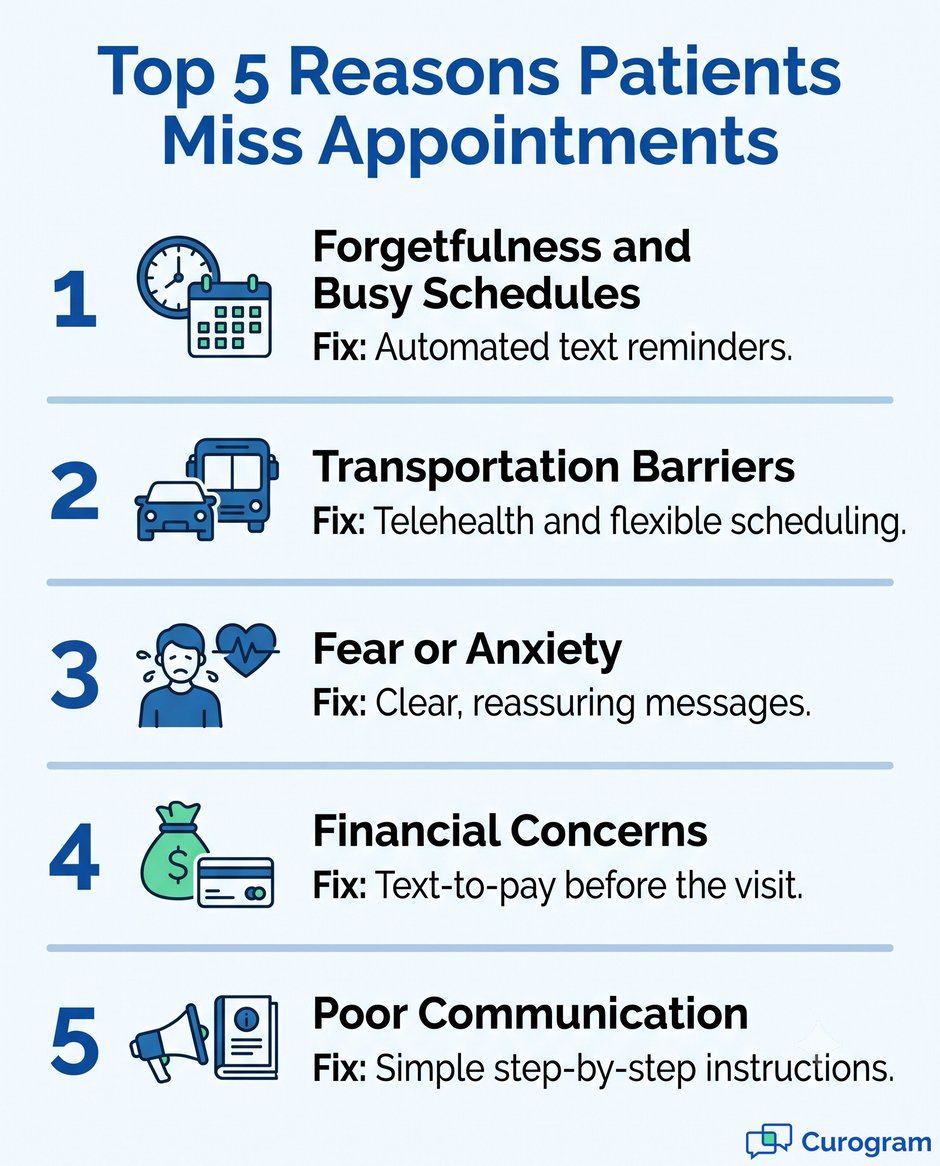
Once you know why patients miss visits, the fixes become clear. A few proven habits can turn a leaky schedule into a reliable one.
One of the most effective moves is sending automated appointment reminders. Texts, calls, and emails timed at 72 hours, 24 hours, and 2 hours out lift attendance sharply. Patients can confirm or reschedule with a single tap. That small convenience removes a lot of friction from the process.
Offering same-day slots, extended hours, or virtual visits lowers the bar to showing up. Telehealth is a lifeline for patients with transportation trouble or unpredictable shifts. When care fits into real life, more patients keep their appointments.
Plain, step-by-step guidance clears up most confusion before it starts. A good reminder can include a location map, fasting notes, or a telehealth link. When patients know exactly what to do, they arrive ready and on time.
Unpaid balances are a real healthcare appointment barrier. Digital payment tools let patients clear what they owe before the visit. Online intake forms trim wait times and cut paperwork errors. Together, these tools create a smoother experience that quietly encourages attendance.

For practices running eClinicalWorks, the schedule already holds everything needed to fight no-shows. The trick is putting that live data to work through smart, connected messaging.
eCW users hold a real edge: access to live scheduling data. Sync that data with a messaging platform and every reminder stays accurate and current. Patients trust reminders that match their real appointments. That trust is what turns a reminder into a kept visit.
Integrated messaging ties reminders, intake, and payment requests back to the EMR. That single thread keeps everything consistent and cuts down on errors. Patients feel the difference when every touchpoint lines up. The result is a smoother, more trustworthy experience.
Instead of leaning on phone calls and generic notices, clinics can add Curogram. It brings a HIPAA-compliant, automated layer that makes every interaction smoother. Reminders sync straight to the eCW schedule with no manual updates. Technology like Curogram can reduce no-shows by up to 75%, based on our internal data.
Patients complete forms securely on their phone before arriving, and the details flow into eCW. Secure HIPAA-compliant texting replaces endless phone tag, so answers come in minutes. Text-to-pay links let patients clear balances before or after the visit. Every payment is logged in eCW, creating a clean audit trail.
This side-by-side view shows how a connected workflow changes each everyday task.
|
Task |
Manual / Phone-Only Approach |
Curogram + eCW Approach |
|---|---|---|
|
Appointment reminders |
Staff call each patient by hand |
Automated texts at 72h, 24h, and 2h |
|
Schedule accuracy |
Reminders can fall out of sync |
Synced live to the eCW schedule |
|
Intake and forms |
Paper forms filled in the waiting room |
Secure mobile forms sent ahead of time |
|
Payments |
Staff chase balances by phone |
Text-to-pay links logged in eCW |
|
Patient response |
Return calls and voicemail tag |
With Curogram, eCW evolves from just a scheduling system into a complete patient communication hub. Every message is secure, every reminder accurate, and every appointment more likely to happen. That means fewer empty chairs, happier patients, and more productive staff—all without adding more manual work.

When you understand why patients miss appointments, the right fixes come into focus. The cost of no-shows reaches far past an empty chair. It touches provider utilization, staff morale, patient satisfaction, and steady growth. The encouraging news is that these gaps are highly preventable.
With the right mix of habits, clinics can shrink no-show rates in a lasting way. That mix usually includes automated reminders, flexible scheduling, digital payments, and tight EMR integration. For eCW users, a platform like Curogram makes each of those moves feel effortless. It brings HIPAA-compliant messaging, smart reminders, and digital intake together in one place.
Fewer missed visits mean healthier patients and a healthier bottom line. The path there is simpler than most teams expect.
Want to see how Curogram helps clinics turn empty slots into kept appointments? Book a quick demo and see the difference for your own schedule.

1 min read
💡 An appointment reminder email is a short, pre-written message a practice sends before a scheduled visit, confirming the date, time, provider,...
1 min read
💡 Missed appointments cost the U.S. healthcare system an estimated $150 billion a year, with each individual no-show costing a physician roughly...
1 min read
💡An appointment confirmation text template is a short, reusable SMS that reminds a client of a booking and asks them to reply and confirm. A good...